
You know something needs attention. Maybe your sleep has slipped, worry follows you to work, or a heaviness just won't lift. Then you start looking for help and run into a wall of titles: psychiatrist, psychologist, therapist, counselor. Which one do you actually call?
If that sounds familiar, you're not alone in this. The good news is that your first choice isn't permanent. A good mental health provider can point you toward a different kind of care if that's what you need.
Here's the short version. A psychologist provides talk therapy and psychological testing. A psychiatrist is a medical doctor who can diagnose, prescribe medication, and manage it over time. Other prescribers, such as psychiatric nurse practitioners, do this too. Many people benefit from working with both.
Below, you'll find a side-by-side comparison, a symptom-based guide to help you decide, and practical next steps. It's written for anyone in Virginia Beach, Norfolk, Chesapeake, or elsewhere in Hampton Roads.
Key Takeaways
Psychiatrists and other prescribers manage medication. Psychologists and therapists provide talk therapy, and psychologists also do testing.
Psychiatrists earn an MD or DO degree and complete a psychiatry residency. Psychologists earn a PhD or PsyD.
You don't need to have it all figured out before your first call.
Many people use both, and coordinated care can make that easier.
The Short Answer: Psychologist vs Psychiatrist, or Both?
If you only read one section, make it this one:
Start with a psychologist or therapist if you want to talk through stress, patterns, trauma, grief, or relationships and build coping skills.
Start with a prescriber if you want to know whether medication could help, especially when symptoms are affecting sleep, appetite, or daily life.
Consider both if symptoms feel moderate to severe or haven't eased with one approach alone.
That last option is more common than many people expect. According to the National Institute of Mental Health, treatment for mental illnesses usually involves therapy (in person or virtual), medication, or a mix of the two.
There's no wrong door here. A therapist can refer you for a medication evaluation, and a prescriber can recommend therapy. This guide is general information, not a diagnosis, so think of it as a starting point for a conversation.
Psychiatrist vs Psychologist: Key Differences at a Glance
The key difference comes down to training and tools. Psychiatry is a branch of medicine, while psychology focuses on thoughts, emotions, and behavior. Here's how psychiatrists and psychologists compare, with therapists and counselors included for context.
| Psychiatrist | Psychologist | Therapist / Counselor | |
|---|---|---|---|
| Training & degree | MD or DO (medical doctor) | PhD or PsyD (doctoral degree in psychology) | Master's degree (for example, LPC or LCSW) |
| Education path | Medical school, then a psychiatry residency | Doctoral program, then supervised clinical hours and licensure | Master's program, then supervised clinical experience and licensure |
| Can prescribe medication? | Yes | Generally no; a few states allow it with extra training | No |
| Provides talk therapy? | Some do; many focus on medication | Yes, a core part of the role | Yes, a core part of the role |
| Psychological testing | Not usually; may refer out | Yes | Limited; varies by training |
| Typical focus | Diagnosis, medication, medical factors | Therapy, testing, diagnostic clarity | Therapy, coping skills, support |
| Typical visit | An initial evaluation, then follow-ups on how medication is working | Regular therapy sessions, often weekly or every other week | Regular therapy sessions, often weekly or every other week |
| Cost & insurance | Fees vary; coverage depends on your plan | Fees vary; coverage depends on your plan | Fees vary; coverage depends on your plan |
What Is a Psychologist?
A clinical psychologist holds a doctoral degree in psychology, such as a PhD or PsyD. Their training centers on how people think, feel, and behave, and how to help them shift patterns that keep them stuck. According to NAMI, psychologists are trained to evaluate mental health through clinical interviews, psychological evaluations, and testing.
In most states, psychologists don't prescribe medication. A few states allow it for psychologists who complete additional training. According to APA Services, New Mexico was the first state to pass such a law in 2002. It lets psychologists with the right training prescribe psychiatric medications.
What a Psychologist Treats and How
Psychologists help people living with depression, anxiety, trauma, grief, relationship strain, and big life transitions. Many use cognitive behavioral therapy (CBT), which helps you notice unhelpful thought patterns and gently change them. Others use trauma-focused approaches such as EMDR, a structured therapy that helps the brain process painful memories.
Psychologists also provide testing. That might mean an ADHD evaluation, an assessment for learning differences, or testing that clarifies things when symptoms overlap.
Sessions are collaborative. You and your psychologist set goals together, and you practice skills between visits. Many people meet weekly or every other week, but the schedule depends on what you need.
Therapist vs Psychologist: Where Do Counselors and Social Workers Fit?
"Therapist" is a broad, everyday word for anyone who provides psychotherapy. It isn't a license on its own. A licensed professional counselor (LPC) or a licensed clinical social worker (LCSW) usually holds a master's degree, while a psychologist holds a doctorate.
Master's-level counselors and therapists are trained to evaluate your mental health and apply therapeutic techniques learned during their training. In day-to-day talk therapy, these roles overlap a lot. One practical difference is that a psychologist may have more training in formal testing.
For most people, fit matters more than title. A counselor or social worker you connect with can be a great place to start. You can meet our therapists to see the range of backgrounds on our team.
Which professional can prescribe medication?
Psychiatrists can prescribe medication, and so can other qualified prescribers, such as psychiatric nurse practitioners and primary care physicians. Psychologists generally cannot. A few states allow psychologists with additional training to prescribe, but in most places, a psychologist will refer you to a prescriber if medication might help.
What Is a Psychiatrist?
A psychiatrist is a medical doctor (MD or DO) who specializes in mental health. According to the American Psychiatric Association, doctors who choose psychiatry complete a residency of four or more years after medical school. That training covers diagnosing and treating mental health conditions, several forms of psychotherapy, and the use of psychiatric medications and other treatments.
Because psychiatrists are physicians, they can prescribe medication and look at how your physical health affects your mood. Many psychiatrists focus mainly on medication, though some also provide therapy.
So how do they diagnose? Mostly through conversation. MedlinePlus explains that getting a diagnosis can include a medical history and a psychological evaluation. It can also include a physical exam or lab tests if your provider thinks another medical condition could be behind your symptoms. For depression, for example, no lab test can make the diagnosis. Still, your provider may order blood work to check for conditions such as anemia or thyroid disease, according to MedlinePlus depression screening.
Clinicians also compare what they learn with the DSM-5-TR, the American Psychiatric Association's diagnostic manual. For each condition, it lists diagnostic criteria, or symptoms, that clinicians evaluate.
How Medication Management Works
Medication management is the ongoing work of choosing, adjusting, and monitoring medication. It starts with a detailed first evaluation of your symptoms, history, and goals. Follow-up visits then check how you're feeling, whether a dose needs to change, and how you're handling any side effects.
Common options include SSRIs and SNRIs, two families of antidepressants. SSRIs act mainly on serotonin, a brain chemical involved in mood. SNRIs act on both serotonin and norepinephrine. Zoloft and Lexapro are familiar SSRIs. According to NIMH's medications guide, medications are often used alongside other treatments, such as psychotherapy and brain stimulation therapy. If you're curious, here's how SSRIs and SNRIs differ.
Every treatment plan is individual. Never start, stop, or change a medication on your own. Your prescriber is the right person for those questions. Our guide on what antidepressant side effects are common and when to call can help you prepare for that conversation.
Psychiatrists, Psychiatric Nurse Practitioners, and Other Prescribers
A psychiatrist isn't the only mental health professional who can evaluate patients and manage medication. Psychiatric nurse practitioners are advanced practice nurses with specialized mental health training. NAMI notes that they can provide assessment, diagnosis, and therapy for mental health conditions or substance use disorders. Primary care physicians also prescribe for many common concerns.
At Beach Counseling Center, psychiatric nurse practitioners and other prescribers provide our medication management. You can learn more about our medication management providers.
Difference Between a Psychologist and Psychiatrist: Training, Tools, and Treatment
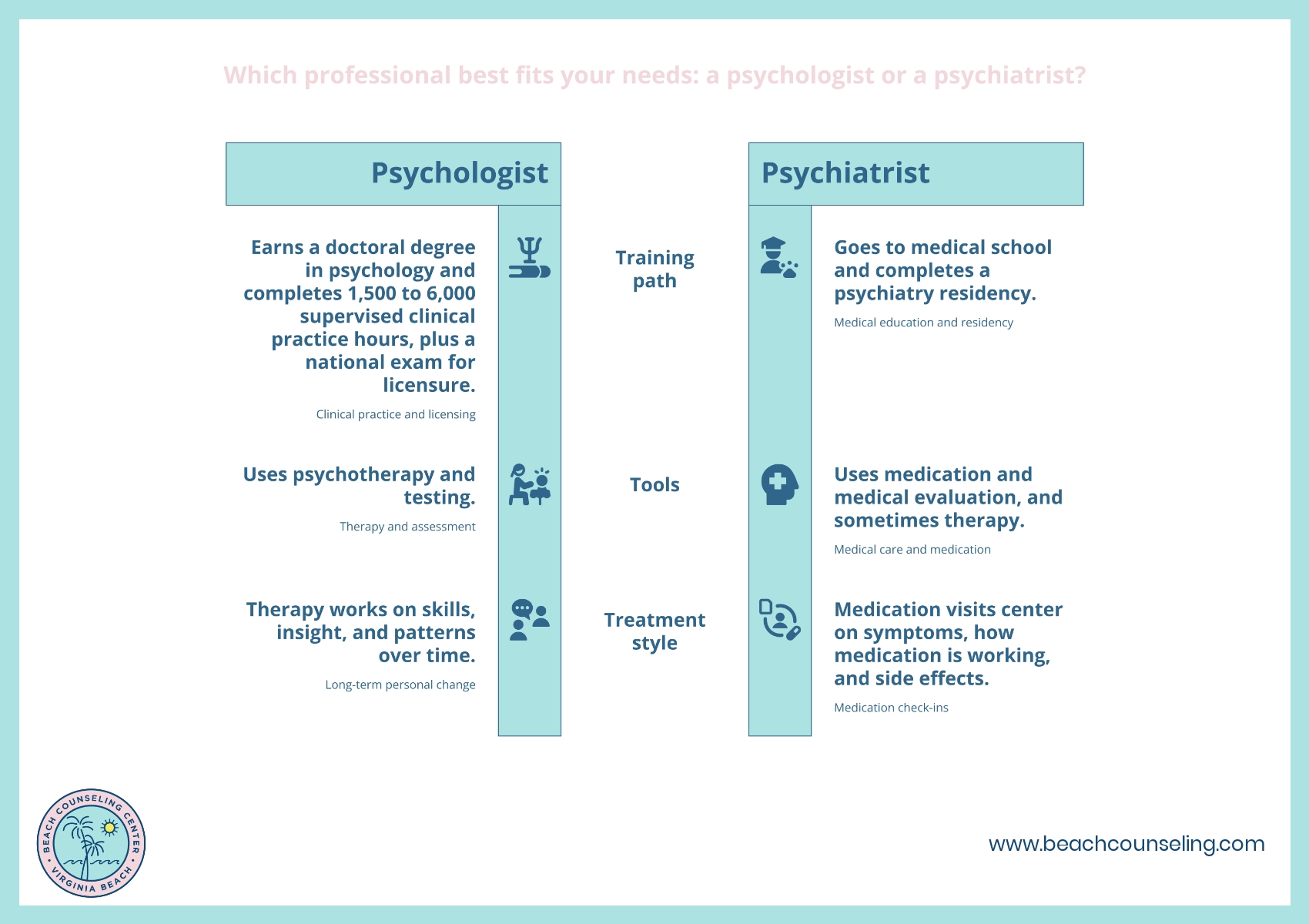
Training path. Psychiatrists go to medical school and then complete a psychiatry residency. Psychologists earn a doctoral degree in psychology. According to APA Services, psychologists must also complete between 1,500 and 6,000 hours of supervised clinical practice and pass a national exam to become licensed. The exact rules vary by state.
Tools. A psychologist's main tools are psychotherapy and testing. A psychiatrist's tools include medication, medical evaluation, and sometimes therapy.
Treatment style. Therapy works on skills, insight, and patterns over time. Medication visits center on symptoms, how the medication is working, and side effects.
You may have heard that psychiatrists treat "serious" conditions and psychologists treat "less serious" ones. That's outdated. Both diagnose and treat mental health disorders of all kinds, from anxiety to bipolar disorder. Their roles often overlap and support each other.
A Quick Note on Career Paths
If you're a student weighing psychology vs psychiatry as a career path, the main fork is medical school. Psychiatry runs through medical school and residency. Psychology runs through a doctoral program, supervised training, and licensure. The American Psychiatric Association and the American Psychological Association both publish detailed guides to each route.
Do I Need a Psychiatrist or Psychologist? Match Your Situation to the Right Provider
Most guides stop at definitions, so here's some help deciding. Use these as starting points, not rules. Your first provider can adjust the plan with you.
When to Start With a Psychologist or Therapist
Stress or worry that's hard to switch off
Relationship or family strain
Big life transitions, like a new job, a deployment, a divorce, or becoming a parent
Wanting practical coping skills
Needing testing for ADHD or learning differences
When to Start With a Prescriber
Symptoms that disrupt your sleep, appetite, energy, or ability to work
You've previously taken medication that helped, or didn't help, and want to revisit your options
Questions about ADHD medication
A therapist who has suggested a medication consult
Wanting to know whether medication is an option for you
When You Might Need Both
Many people see a psychologist and a psychiatrist (or another prescriber) at the same time. This is common with moderate to severe depression, anxiety disorders, PTSD, bipolar disorder, or symptoms that haven't improved with one approach alone.
Here's what that can look like. You meet weekly with a therapist to work on panic triggers and sleep habits. About once a month, you check in with a prescriber about a medication you recently started. With your permission, the two of them share updates, so you aren't repeating your story or passing messages between offices.
If You're in Crisis
If you're having thoughts of harming yourself or don't feel safe, please call or text the 988 Suicide & Crisis Lifeline. For a medical emergency, call 911. Beach Counseling Center isn't an emergency service, but we can support your ongoing care once you're safe.
Not Sure Where to Start? Talk With Our Team.
You don't have to sort this out alone. We offer in-person and telehealth appointments with minimal wait times, and therapy and medication management under one roof. Call (757) 233-1500 or request an appointment. You can also explore medication management in Virginia Beach.
What kind of doctor is best for mental health?
There isn't a single best type of provider. The right mental health care depends on your needs. A psychologist or therapist is a strong fit for talk therapy, while psychologists can also provide formal psychological testing. A prescriber helps when medication may play a role. Many people do well with both, especially when their providers coordinate care.
How Psychologists and Psychiatrists Work Together
Collaborative care means your providers stay on the same page. Your therapist handles the weekly work of building skills, processing hard experiences, and noticing patterns. Your prescriber handles medication, from choosing a starting point to adjusting doses and watching for side effects.
Your providers share information only with your consent, and you decide what's shared. If privacy matters to you because of your job or professional license, it's reasonable to ask about how your records are handled during your first visit.
When both providers work in the same private practice, coordination tends to be simpler. Scheduling, records, and updates live in one place. For working parents, shift workers, and anyone juggling a lot, that can make it easier to stay engaged in care.
What to Expect: Cost, Insurance, Referrals, and Your First Visit
Do you need a referral? Often not for therapy, but it depends on your insurance plan. Some plans require one for certain visits, so check with your insurer first.
Insurance. Therapy and medication visits are often billed differently. Coverage, copays, and deductibles depend on your plan. Ask your insurer what it covers for outpatient mental health care and whether a provider is in network.
Your first visit. You'll be asked what's going on, how long it's been happening, what your health history looks like, and what you'd like to change. It's a conversation, not a test.
It helps to bring:
A list of your current medications and supplements
Notes on your sleep, mood, and energy
Any past diagnoses or treatment
Your questions, written down so you don't forget them
How do psychiatrists diagnose?
Psychiatrists diagnose through a detailed clinical interview about your symptoms, history, and daily life. They compare what they learn with criteria in the DSM-5-TR, published by the American Psychiatric Association. They may also recommend a physical exam or lab work to rule out medical causes, such as thyroid problems.
Book Therapy and Medication Management in One Place at Beach Counseling Center in Virginia Beach
Psychologists and therapists help you understand patterns and build skills. Prescribers evaluate whether medication could help and manage it over time. At Beach Counseling Center in Virginia Beach, our licensed clinical psychologists, licensed professional counselors, and clinical social workers provide therapy and psychological evaluations, including ADHD evaluations. Our prescribers provide medication management at Beach Counseling Center. Care is available in person or through telehealth for clients in Virginia Beach, Norfolk, Chesapeake, Suffolk, Portsmouth, and across Hampton Roads.
If you aren't sure which one to start with, that's okay. Call (757) 233-1500 or request an appointment, and our team can help match you with a therapist, a prescriber, or both. You can also email info@beachcounseling.com or meet our therapists before your first visit.
